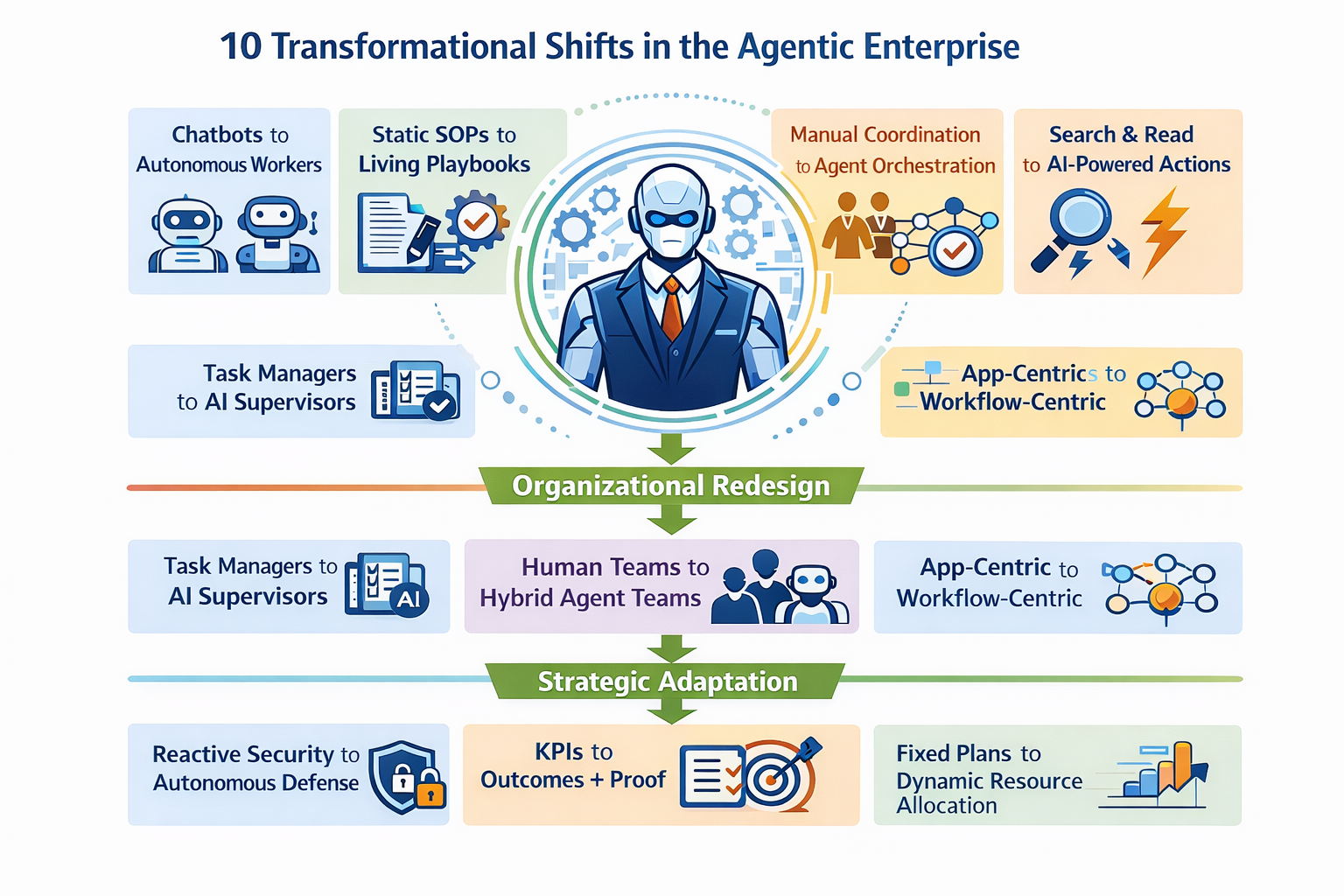
The Agentic Enterprise: Shifts That Will Redefine How Organizations Operate
Artificial intelligence is entering a new phase. For the past decade, enterprise AI has largely been about prediction, recommendations, and conversational interfaces. Systems could analyze data, generate insights, or answer questions. But a new category of AI is emerging — Agentic AI.
These systems don’t just provide information. They take actions, execute workflows, coordinate systems, and achieve outcomes with minimal human intervention.
This shift moves AI from being a tool employees use to becoming a participant in how work gets done.
The impact is not limited to technology. It will reshape operations, management, software architecture, and even organizational design.
Below are 10 structural shifts enterprises will experience as agentic AI becomes embedded into everyday work.
1. From Chatbots to Autonomous Workers
The first generation of enterprise AI was conversational.
Employees asked questions, and AI provided answers. Chatbots improved customer support, internal knowledge search, and basic automation.
However, these systems were fundamentally passive. They waited for instructions.
Agentic AI introduces something different: systems that execute tasks end-to-end.
Instead of simply generating responses, an AI agent might:
- Resolve a customer ticket
- Trigger workflows across multiple systems
- Process approvals
- Schedule follow-ups
- Update records across enterprise software
The interaction shifts from:
“Ask → Answer”
to
“Goal → Execution.”
Organizations will increasingly treat agents not as tools, but as digital workers responsible for outcomes.
Implication for enterprises
Start identifying workflows where AI can own execution, not just assist humans.
2. From Static SOPs to Living Operational Playbooks
Most enterprises rely heavily on Standard Operating Procedures (SOPs).
These documents typically live in:
- Internal wikis
- Shared documents
- PDFs
The problem is that they quickly become outdated.
Processes evolve faster than documentation. Teams often rely on tribal knowledge rather than written procedures.
Agentic systems create an opportunity to transform SOPs into living operational playbooks.
AI agents can:
- Monitor how processes are executed
- Identify inefficiencies
- Recommend workflow improvements
- Surface deviations from expected procedures
Rather than updating SOPs manually every few months, organizations can evolve processes continuously based on operational data.
Implication for enterprises
Process knowledge should move from static documents to systems that can observe, learn, and improve workflows over time.
3. From Human Coordination to Agent Orchestration
A surprising amount of enterprise work is actually coordination work.
Employees spend time:
- Routing requests
- Scheduling tasks
- Tracking approvals
- Chasing updates across teams
This coordination overhead often consumes more time than the actual work itself.
Agentic AI systems can orchestrate these processes automatically.
Agents can:
- Route tasks to appropriate systems
- Trigger downstream workflows
- Coordinate between tools and teams
- Monitor execution across systems
Instead of humans acting as operational coordinators, AI becomes the orchestration layer of enterprise operations.
Implication for enterprises
Audit where your teams spend time coordinating between tools and teams. These coordination points are prime candidates for agent-driven orchestration.
4. From “Search & Read” to AI-Mediated Knowledge Work
Modern knowledge work relies heavily on information discovery.
Employees constantly search through:
- Internal documentation
- Dashboards
- Emails
- Knowledge bases
The process usually looks like this: Search → Read → Interpret → Act.
Agentic AI compresses this entire chain.
An agent can:
- Retrieve relevant information
- Synthesize insights
- Trigger the next operational step
Instead of employees searching for policies or data, the AI agent retrieves the evidence and executes the required action.
Knowledge work becomes action-oriented rather than search-oriented.
Implication for enterprises
Knowledge infrastructure must evolve from content storage systems to retrieval and action platforms accessible by AI agents.
5. From Task Management to AI Workflow Supervision
Managers spend significant time tracking execution.
Common management tasks include:
- Checking status updates
- Monitoring progress
- Following up on deliverables
- Resolving routine escalations
Agentic systems introduce a new operational layer: AI workflow supervision.
Agents can monitor operational processes and:
- Detect anomalies
- Escalate issues
- Identify stalled workflows
- Highlight risks early
Human managers increasingly shift from monitoring tasks to supervising automated systems.
Implication for enterprises
Management roles will evolve toward goal setting, oversight, governance, and escalation management.
6. From Application-Centric Work to Workflow-Centric Work
Enterprise software was designed around applications.
Employees navigate multiple tools such as:
- CRM systems
- Ticketing systems
- Project management platforms
- Collaboration tools
Work requires constant context switching between these systems.
Agentic AI changes the interaction model.
Instead of users navigating applications, AI agents execute workflows across systems using APIs.
Employees interact with workflow outcomes, not individual applications.
Over time, the enterprise interface shifts from apps to orchestrated workflows.
Implication for enterprises
Evaluate enterprise tools not just by features but by how easily they integrate into automated workflows and agent ecosystems.
7. From KPIs to Outcome + Proof
As AI agents take on more responsibility, trust becomes critical.
Organizations cannot rely on opaque systems making autonomous decisions without accountability.
Enterprises will increasingly require:
- Audit trails
- Traceability
- Evidence for decisions
- Explainable outputs
This creates a new operational requirement: Outcome + Proof.
AI systems must not only achieve results but also demonstrate how those results were produced.
This is especially critical for industries involving compliance, finance, and regulated environments.
Implication for enterprises
AI systems should be designed with traceability, logging, and explainability built into the architecture.
8. From Human-Only Teams to Hybrid Agent Teams
Traditional organizational design assumes that work is performed entirely by humans.
Team structures, budgets, and reporting hierarchies are all based on human headcount.
Agentic AI introduces a hybrid workforce model.
Teams will increasingly consist of:
- Human employees
- AI agents
- Automated workflows
The challenge becomes not just managing people, but designing human-AI collaboration models.
Some functions may remain human-heavy, while others become largely agent-driven.
Implication for enterprises
Workforce planning will increasingly consider human capacity and AI capacity together.
9. From Reactive Security to Autonomous Cyber Defense
Cybersecurity is becoming increasingly complex and fast-moving.
Traditional security models rely on human analysts responding to alerts after threats are detected.
However, modern attacks can evolve faster than manual responses.
Agentic AI enables autonomous defense systems that continuously monitor infrastructure.
Security agents can:
- Detect anomalies in real time
- Isolate compromised systems
- Revoke credentials
- Trigger containment protocols
This shifts cybersecurity from reactive incident response to continuous autonomous defense.
Implication for enterprises
Security teams will focus more on strategy, governance, and oversight of automated defense systems.
10. From Fixed Planning to Dynamic Resource Allocation
Most enterprises still operate on annual planning cycles.
Budgets, staffing, and priorities are defined months in advance.
In a rapidly changing environment, this rigidity creates inefficiencies.
Agentic AI enables more dynamic operational models.
Agents can continuously analyze:
- Operational performance
- Customer demand
- Market signals
- Resource utilization
Based on this data, systems can recommend — and eventually automate — resource reallocation in real time.
Organizations move from static planning toward continuous optimization of resources.
Implication for enterprises
Real-time operational visibility becomes essential for dynamic decision-making.
The Bigger Picture
Agentic AI is not simply another enterprise technology trend.
It represents a deeper shift in how work is structured.
Historically, organizations were designed around human coordination and manual workflows.
In the coming decade, enterprises will increasingly operate through automated systems coordinating people, data, and processes at scale.
The organizations that succeed in this transition will not simply deploy AI tools.
They will rethink how work itself is organized.
Because the real transformation is not just AI inside enterprises.
It is the emergence of the agentic enterprise itself.